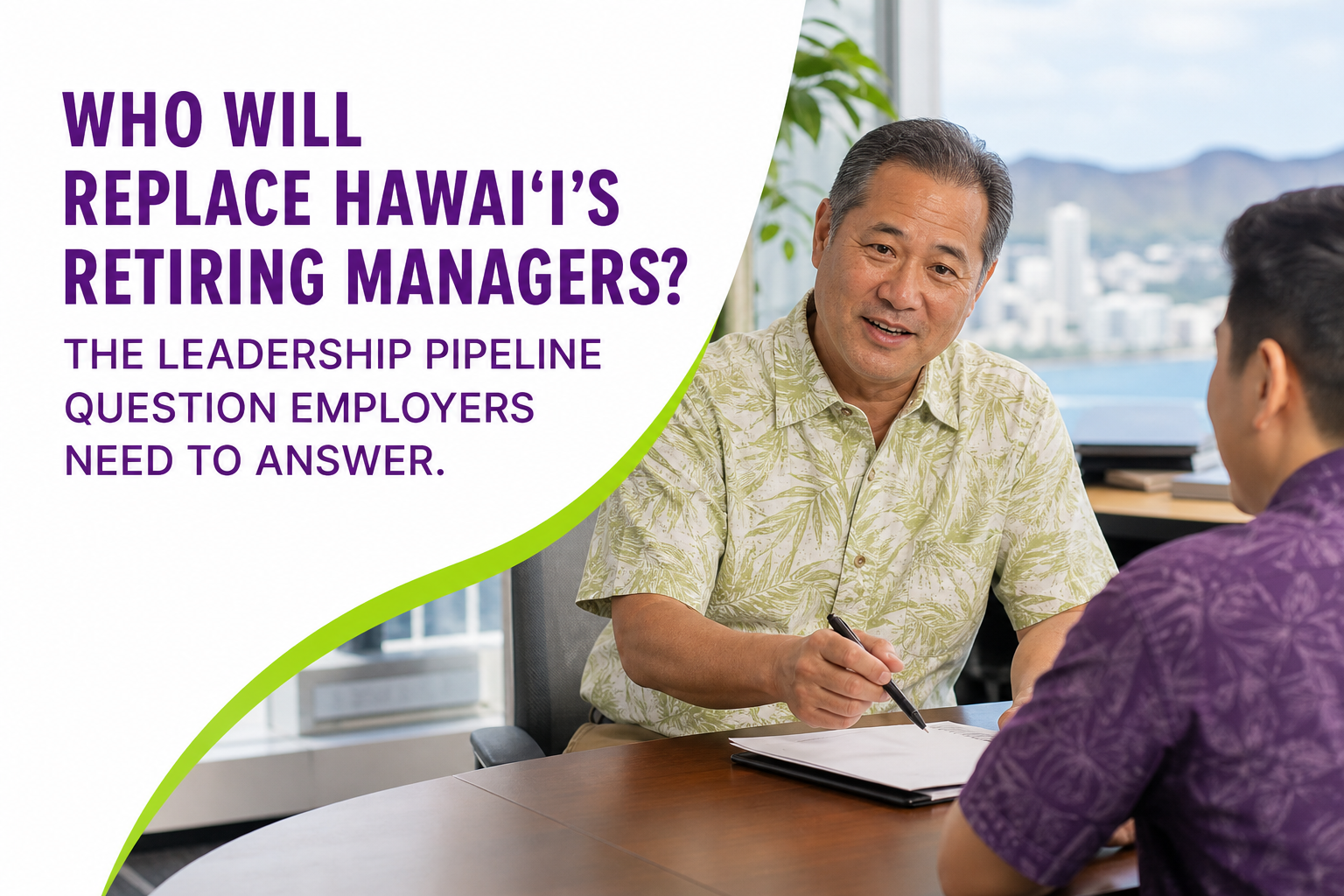
For many Hawaiʻi organizations, succession planning is becoming a practical workforce issue.
Experienced managers and senior leaders often carry much more than their job titles suggest. They understand the organization’s history, know its customers and community relationships, have earned the trust of their teams, and possess years of institutional knowledge that cannot simply be transferred through a job description.
When one of those leaders retires, the challenge is not just filling an open position. It is determining who is actually prepared to lead next.
That is a question Hawaiʻi employers should be answering before the retirement announcement arrives.
A Leadership Vacancy Is Different From Most Open Positions
When an employee leaves, organizations can usually identify the work that needs to continue and begin searching for someone with the appropriate skills.
Leadership transitions are more complicated.
A manager may oversee employees, make operational decisions, manage important relationships, resolve problems, train others, understand unwritten processes, and serve as a connection between senior leadership and the rest of the organization.
Replacing that person requires more than matching experience on a resume.
Employers need to consider which responsibilities can be transferred, which relationships need to be preserved, what leadership capabilities the next person will need, and whether the organization has someone internally who is genuinely prepared to take on the role.
Your Strongest Employee Is Not Automatically Your Next Manager
Internal promotion can be an excellent succession strategy, particularly when an employee already understands the organization, its people, and the Hawaiʻi community it serves.
But strong performance in one role does not automatically translate into readiness to lead others.
An experienced individual contributor may have outstanding technical or professional expertise without yet having experience managing performance, resolving conflict, setting priorities, developing employees, or making decisions for an entire department.
Before assuming a future leadership opening can be filled internally, organizations should evaluate potential successors based on the responsibilities they will inherit, not simply how well they perform in their current positions.
If someone has leadership potential but is not ready today, identifying that gap early creates time for development.
Some Leadership Gaps Require an External Search
Succession planning should not begin with the assumption that every leadership position must be filled internally.
Sometimes an organization needs capabilities that do not currently exist on the team.
Growth may require a different type of operational experience. A department may need stronger technical expertise. An organization undergoing change may need a leader who has managed a similar transition before.
In those situations, an external search can complement the organization’s internal leadership pipeline.
The key is knowing early enough that an external search will be necessary.
Waiting until a long-tenured manager has already departed can put pressure on an organization to make one of its most consequential hiring decisions quickly.
Institutional Knowledge Needs Its Own Succession Plan
Leadership transitions also expose another risk: knowledge that exists primarily with one person.
Long-tenured managers may know why certain processes exist, which relationships require particular attention, how previous challenges were handled, and where potential problems are likely to emerge.
Much of that information may never appear in a procedure manual.
Organizations anticipating leadership transitions should identify what knowledge needs to be transferred before focusing solely on who receives the departing employee’s title.
That might include documenting important processes, transferring key relationships, involving potential successors in decisions, or creating overlap between an outgoing leader and the person taking on new responsibilities.
A successful succession is not simply a change in personnel. It is a transfer of capability.
Start With the Positions You Cannot Afford to Leave Unprepared
Not every management position presents the same succession risk.
Hawaiʻi employers can begin by identifying the roles where a departure would have the greatest effect on operations, employees, customers, or organizational knowledge.
Then ask:
- Is there someone internally who could realistically assume this position?
- What capabilities would that person still need to develop?
- What knowledge would be difficult to replace if the current leader left?
- Does the organization need the next leader to bring skills it does not currently have?
- If an external search becomes necessary, how specialized will the candidate profile be?
- How much time would the organization realistically want to make the right hire?
These conversations can help turn succession planning from a future concern into a practical workforce strategy.
Hawaiʻi Employers Need to Build the Next Layer of Leadership
The leadership pipeline is not only about replacing executives.
Department managers, HR leaders, operations managers, IT leaders, finance professionals, and other experienced managers often form the layer of leadership that keeps an organization functioning every day.
When organizations develop those employees intentionally, they create more options for future succession.
When they do not, a retirement can reveal a leadership gap that has been developing quietly for years.
The best time to discover that gap is not when the position becomes vacant.
Plan for Your Next Leadership Transition With Bishop & Company
For more than 20 years, Bishop & Company has helped Hawaiʻi organizations recruit experienced local professionals and leaders who understand the market and the communities they serve.
If an upcoming retirement, organizational change, or leadership gap is creating a critical hiring need, our team can help you evaluate the local talent market and conduct a focused search for the right person to lead what comes next.
Contact Bishop & Company to discuss your leadership hiring needs.
Leave A Comment